Freight doors have a way of attracting trouble. They sit at the back of the building, out of sight, where pallets stack up, drivers hustle on deadlines, and the air smells faintly of diesel and cardboard. That’s where opportunists linger. They look for the open man door during a busy load, the unlatched roll-up at lunch, or the unattended receiving lane after 5. If you run a shipping dock, you don’t need a sermon on risk. You need something that keeps movement flowing and temptation out. That’s the sweet spot for scissor security gates.
I have installed, specified, and lived with these in enough warehouses to know the difference between a gate that looks tough and a gate that changes behavior. Properly chosen and installed, expanding security gates control access without strangling operations. They send a message, they stand up to hard use, and they do it without requiring a new electrical circuit or a training video.
Why scissor gates fit the dock
A freight dock has conflicting demands. You need air moving through the bay to keep fumes down. You need eyes on the apron so receivers can wave down a driver or spot a stray forklift. You need quick transitions from open to secure as shifts start and end. Full metal grilles and roll-down shutters have their place, but they often turn the dock into a cave, then slow people down with motors and key switches. Scissor security gates, sometimes called accordion security gates or expanding security gates, hit the balance: see-through, breathable, fast to deploy, and hard to shove aside.
Picture a pair of steel lattice gates that collapse to a neat stack beside the door when you need clear access, then slide and lock across the opening when you don’t. The design concentrates strength in a crisscross of riveted or welded steel. Force applied at one point spreads across the pattern. A determined intruder meets a flexible barricade that absorbs blows, resists prying, and buys time. For commercial security gates, time is the currency.
There’s also the human factor. A visible barrier changes behavior on your side of the door too. People respect a gate. They don’t prop it with a broom, and they don’t forget to close it the way they forget a latch on a hollow-core man door. In a busy shipping area, that difference shows up in your incident log.
Where they work best
Not every opening deserves a scissor gate. Some do. If you recognize any of these scenes, you’re a good candidate:
The seasonal overload. Retail distribution ramps up in November. Your trailers line the lane, your roll-up doors stay open, and foot traffic turns chaotic. A gate lets you keep doors open for airflow while choking off opportunistic wanderers and grab-and-go theft near the staging floor.
The shared loading dock. Multi-tenant buildings bring unpredictability. Drivers appear early. Cleaners use the exterior stairs after hours. A floor-to-ceiling gate across your unit’s dock line separates your inventory from someone else’s problems.
The “will call” window that isn’t a window. Contractors love to pick up at the dock. Your team passes boxes through a half-open door, and a well-meaning employee ends up letting a stranger into the stock aisle. A half-height gate inside the opening creates a counter line that relieves pressure and clarifies boundaries.
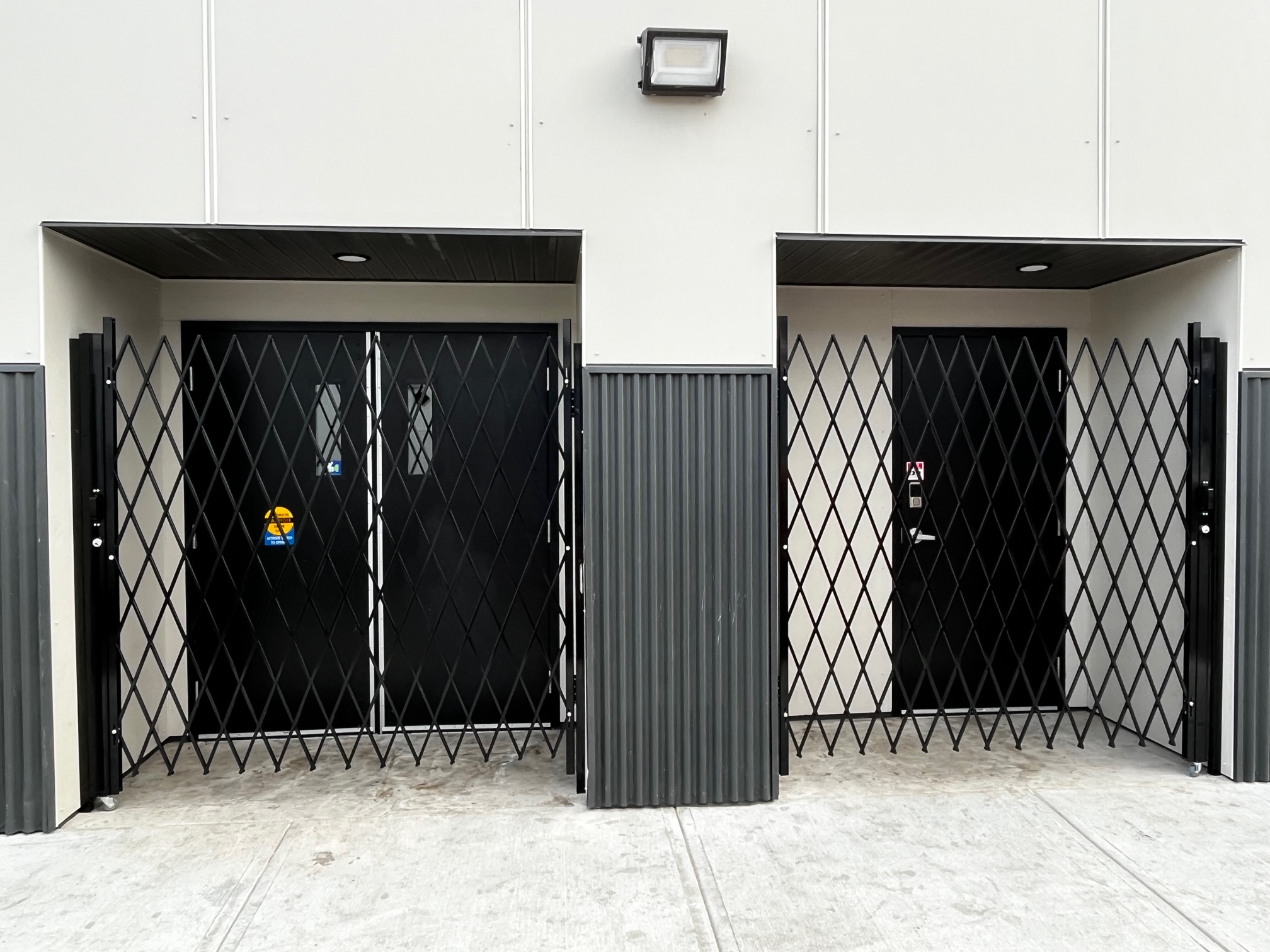
The cross-dock with constant air exchange. Big volume, fast turns, forklifts threading through. Roll-ups should be open. With a pair of scissor gates on a center-drop track, you can close between waves without sending someone to fetch chains and padlocks.
There are also quiet, unglamorous uses. I’ve used a single-leaf gate to lock off a vertical lift’s perimeter while the platform cycles. I’ve seen narrow accordion security gates on man doors tied into the same keyway as front entrances. When a solution prevents one injury or one theft a year, it earns its keep.
Anatomy of a dependable scissor gate
Let’s translate catalog copy into what matters on the wall. You will see variations, but commercial-grade expanding security gates for business share core features.
Steel that carries its weight. Look past shiny powder coat and ask about the gauge. I prefer 14 gauge for the lattice and 1.5 by 1.5 inch angle or channel for the frame, especially on doors wider than 10 feet. Lighter gauges may look fine until a pallet heel clips them and the geometry twists. The gate should flex under load, then rebound, rather than kink like a soda can.
Riveted or welded connections worth their salt. Riveted scissor joints with hardened steel trunnions can survive thousands of cycles without loosening. Welds are fine if they are continuous and avoided in heat-sensitive hinge points. What you don’t want: thin aluminum rivets and decorative spot welds every few inches.
A top guide that does actual guiding. The top bar should ride in a U-channel or glide under a continuous angle, with anti-derail stops at the ends. A single lag bolt into drywall is not a guide. On wide openings, a center drop pin keeps the span from breathing under pressure.
Lock hardware that belongs in a commercial setting. Best case, the gate accepts a standard mortise cylinder keyed to your system. If it’s a simple padlock hasp, make sure it’s shrouded. Exposed padlocks invite bolt cutters. I like gates with a throw bolt that nests into a receiver in the opposite jamb, not just a loop-on-loop clasp.
A finish that isn’t pretending. Powder coat resists chips and looks sharp for years if prep is done right. Galvanized finishes make sense near wash bays or coastal docks. Watch out for cheap coatings that chalk and peel, turning your gate into a dusty mess that stains hands and boxes.
Wheels where needed, and not where they complicate life. Floor casters help on very wide spans or in facilities with uneven floors, but they also collect debris. If your dock is clean and your hardware stout, a suspended gate without a floor track keeps the threshold unobstructed for pallet jacks.
Single, double, and stacking choices
You will hear the standard options: single-leaf, double-leaf, portable, and stack-left or stack-right. The right choice depends on flow.
Single-leaf gates cover narrow man doors and smaller roll-ups up to about 7 or 8 feet wide. They park to one side and lock to the other. Simple, fast, less to maintain. For a high-traffic receiving door, a single-leaf gate that stacks away from the main turn radius of forklifts saves headaches.
Double-leaf gates meet in the middle and lock together. This is the workhorse for 8 to 16 feet wide, common on dock doors. The symmetry keeps each stack manageable, and the center lock, anchored with a drop pin, spreads force. When a driver bumps the gate with a pallet, the load distributes rather than torquing one hinge point.
Stack direction matters more than people think. If you stack to the left and that’s the side you load long materials, you will nick the stack with every awkward bundle. Think about door pull chains, fire pull stations, and switchgear. The gate should not block emergency equipment when parked.
Portable accordion security gates exist, and they can be useful for pop-up staging or temporary corridors, but for dock security they are a stopgap. If theft is more than a rumor, bolt a gate to the structure.
Real-world installation notes
A scissor gate performs only as well as its mounting points. I have turned down installations where I didn’t like the substrate. You need solid blocking, preferably steel or wood anchored to concrete or masonry. If your jamb is hollow metal on a drywall partition, I want to see reinforcement plates or through-bolts and backing. Powdered anchors in crumbly block do not inspire confidence.
Height clearance trips people up. Scissor gates need room to swing their lattice and rest under a header. If your roll-up door hardware crowds the top space, measure twice. I target 2 to 3 inches of clearance from the highest obstruction, more if the floor slopes.
Speaking of floors, check slope across the opening. Docks often pitch toward drains. Over a 10 foot opening, a slope of half an inch can twist a gate enough to bind. Shim the bottom shoes or plumb the top track to keep the lattice square when closed. A crisply aligned gate gets used. A clumsy one gets propped.
Finally, plan the lock height. Waist-high locks are faster and less stressful on backs. If you expect drivers to lock up https://rentry.co/otixrmeh after a late drop, place the lock where they can reach it from ground level outside the dock, not from a raised platform that requires a badge.
Safety without bottlenecks
Security at a dock does not excuse you from life safety rules. A gate that creates a dead end or blocks an egress path during operating hours is a liability. The good news: most jurisdictions accept scissor gates in open position during occupancy, then locked after hours. If you need a gate for daytime use, specify a model with a quick-release panic latch on the interior side, and confirm with your local code official.
Visibility is a friend. A see-through barrier allows supervisors to spot hazards, check for pedestrians behind a trailer, and manage the dock plate without stepping into the lane. Mesh screens and solid roll-downs can hide a person or a forklift until it’s too late. Scissor patterns keep line of sight while discouraging passage. That’s not a small difference.
If you operate in a high-heat region, or in a shop with fumes, a gate lets you ventilate while controlling access. I have seen workers run box fans at the threshold behind a locked gate during battery charging cycles. The airflow clears the space, and the barrier keeps the curious from wandering into an area with charging leads and PPE requirements.
Integrating gates with everyday flow
The best expanding security gates disappear into your operations. They open when they should, close when they should, and demand little attention. That takes habit and a touch of design.
Teach the close at shift change. Tie the gate to your dock checklist: lights, plates, paperwork, gate. The team will learn the muscle memory. If you have a security office, have them audit the lockup with a quick camera sweep. Most gates are visible from a standard bay camera because of their silhouette.
Park the stacks where they don’t snag. If you have a fire door or a high-traffic aisle, choose a stack side that keeps the lattice away from hand trucks and corners. It sounds like nitpicking until you replace a bent knuckle because someone clipped it with a moving dolly.
Keys matter. If your facility uses a master key system, make sure your scissor security gates accept it. I have seen otherwise good installs neutered by a lonely padlock that sits on a chain no one can find. If you must use padlocks, color code them, engrave dock numbers, and keep spares in a controlled cabinet.
Coordinate with delivery partners. Once you install gates, give carriers clear instructions. Many sites allow drivers to bring pallets into a vestibule while the gate remains locked, then your staff takes it from there. It reduces tailgating and casual intrusion. Consistency counts.
Theft, the quiet math
Theft at docks rarely looks like a movie scene. It’s slipstream stuff: a carton of electronics that never makes it from receiving to inventory, a bag of high-value components that disappears during a smoke break. In the worst case, an intruder slips into the warehouse during a lunch window and heads straight for small-parts storage. Your security camera shows a blur.
A gate does not make theft impossible. It makes it noisy. A person has to climb, pry, or cut, and that takes time and creates attention. When you lock a gate across the roll-up at the end of a shift, you remove the easy entry point that people exploit in the 10 minutes before the alarm sets. When you lock a gate behind an open man door during a summer day, you prevent casual walk-ins that lead to what police call crimes of opportunity. That’s the math: every barrier that converts a quiet theft into a loud attempt lowers your risk.
For a rough yardstick, sites that install commercial security gates at their docks often report incident reductions in the first quarter. I have seen shrink drop by 20 to 40 percent in parts rooms near docks after adding gates and a few procedural changes. Your mileage depends on what you stock, your neighborhood, and your discipline. The gate is a lever, not magic.
Durability: what fails and why
When scissor gates fail, they usually fail at the joints and the mount. The lattice loosens and drags, or the top guide pulls out of a weak substrate. You can prevent both.
Specify steel that exceeds your opening width, not just matches it. A 12 foot door calls for a gate designed to span 12 feet without reliance on heroic tension. That gives you reserve strength when the forklift inevitably nudges the stack. For hinges and rivets, ask about life cycles. Manufacturers who test will tell you their numbers.
At installation, insist on through-bolts or anchors sized for pull-out strength in your specific wall type. If your wall is filled CMU, use proper sleeve anchors or adhesive anchors with enough embedment. If it’s poured concrete, wedge anchors from reputable brands with correct torque settings. Overkill here means sleeping better later.
Keep grit away from sliding points. Gates live near asphalt dust, pallet splinters, and stray shrink wrap. Once a quarter, blow out the top track with compressed air and a light brush. Wipe the lattice where it rides. That ten minute ritual buys you years.
A note on aesthetics and messaging
People underestimate the psychological lift of a clean, well-finished gate. It signals control. It shows that you care enough to keep the perimeter tidy. I have walked into messy docks with bent gates that looked like afterthoughts, and the vibe screamed come try me. A crisp powder coat in your standard safety color, a lock that lines up without wrestling, and a consistent routine communicate that you are not an easy mark.
There is also community messaging. If your facility fronts a public alley, a closed scissor gate over a roll-up gives neighbors a sense that the place is watched. It reduces vagrancy inside recessed doorways. It reduces the chance of someone using the dock as overnight shelter, which often leads to more serious problems. Compassion and security can coexist, but it starts with clear boundaries.
Choosing a security gate supplier
The product is half the equation. The partner who measures, installs, and supports it is the other half. When you vet a security gate supplier, ask about field experience at docks similar to yours. A firm that has hung dozens of scissor security gates for business and can describe their failures candidly is worth more than a catalog pusher.
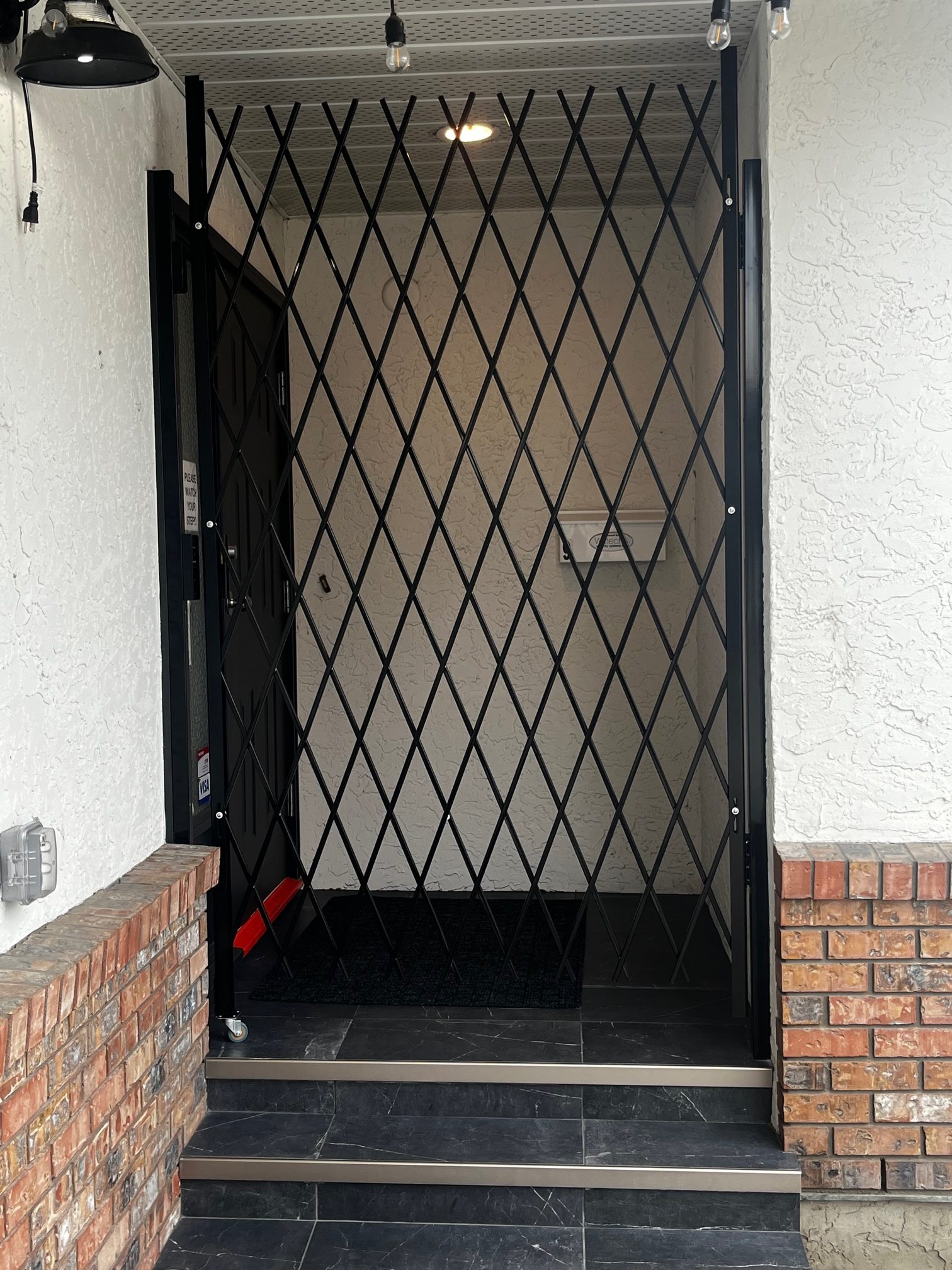
Look for responsiveness. If a truck clips your gate on a Friday and your dock sits half-secure all weekend, you learn quickly who picks up the phone. Suppliers who stock common widths and heights can save you weeks. If you are in the Okanagan or Interior BC, there are specialists who know the climate and the building stock. I have worked with teams offering expanding security gates Kelowna businesses rely on for high wind exposures and sloped apron geometry. That local nuance matters when your dock doesn’t sit perfectly flat and square.
Integration with your lock system is another test. A good supplier will coordinate cylinders with your security vendor, match keyways, and deliver gates ready to accept your cores. They will tap holes for conduits if you plan to tie a contact into your alarm. The best even pre-check with your fire marshal if you want daytime use with a panic release.
Cost and the case for upgrades
Prices vary widely by size, finish, and brand, but for budgeting, a single-leaf scissor gate for a man door might land in the low four figures installed. A robust double-leaf for a 10 to 12 foot dock door often runs mid four figures. Toss in galvanized finish or custom colors, and you might add a few hundred. Compared to motorized roll-down grilles, you are still spending a fraction, and you avoid the electrician’s bill.
The cost question gets boring when you compare it to the wrong reference. Don’t ask if the gate is cheaper than the last time you replaced a cylinder. Ask if it is cheaper than the one theft that keeps you late on a Friday inventory. For many operations with small high-value items, one incident pays for several gates.
If you have older accordion security gates that sag and bark your shins, resist the patchwork. A gate past its prime is more than an annoyance. It teaches people to leave it open. If the lattice is bent, the top mount loose, or the lock no longer lines up, replace rather than repair unless the frame is newer. Newer designs shrink to tighter stacks, clear taller hardware, and accept modern lock bodies. They also look less like something you stole from a shuttered mall.
Edge cases and exceptions
Not every dock benefits. A temperature-controlled food facility that must maintain a tight thermal envelope won’t see much value, since the roll-up can’t sit open anyway. A high-seismic site with sensitive equipment might prefer a rigid door with defined load paths over a flexible lattice during a shake. If your insurance or AHJ demands a rated barrier on an opening to a hazardous area, scissor gates won’t satisfy that line in the code. They are a deterrent, not a fire barrier.
There is also the lone wolf problem. If insider theft worries you more than opportunists, a gate is only part of a layered approach. Limit who has keys. Audit. Use cages for high-risk stock. Train. Gates keep strangers out. They don’t reform your culture.
A short, practical checklist for your dock
- Measure the opening at top, middle, and bottom to catch slope or bowing. Decide on stack side with traffic patterns in mind, then mock it with tape on the floor. Choose lock hardware that matches your key system or plan a shrouded padlock. Confirm mounting substrate and anchor strategy before ordering. Brief the team on close-open routines and where the key lives.
A tale from the receiving lane
A few winters back, a client with a small electronics distribution operation called about recurring shrink. Nothing heroic, just two or three cartons a month missing from inbound. Roll-ups stood open most days because the heaters couldn’t keep up anyway. The manager didn’t want to spend on motorized grilles. We put in double-leaf scissor security gates on three bays, keyed to their system, and added one waist-high swing gate inside to create a will-call counter from a corner of the dock.
The ritual changed overnight. Doors stayed open, gates closed between loads. Drivers slid cartons through to the will-call zone, then backed out. A supervisor could step over to inspect, but pedestrians couldn’t wander in. Over the next quarter, missing cartons dropped to near zero. We didn’t catch a thief on camera. We just made the easy path harder. The total invoice was less than the cost of one month of losses. The manager started sleeping better, which no spreadsheet captures.
Bringing it all together
Scissor security gates earn their keep in freight and shipping areas because they think like a dock. They respect air and light. They shrug off rough handling. They add friction to the wrong kind of movement while letting the right kind pass. They don’t need electricity, they don’t blow your budget, and they don’t force you to change how you load a truck. They ask for honest installation, a bit of maintenance, and a habit of locking them.
When you weigh options, keep your goal simple. You want a barrier that fits into the tempo of your work. If it’s visible, easy to use, and anchored like it means it, it will change behavior. That’s the job. A good security gate supplier will help you get the details right, from the gauge of the steel to the height of the lock. If you operate in a place like Kelowna where winter grit and summer heat both get a say, local expertise pays dividends. Choose for the reality of your dock, not the brochure.
If you walk your receiving lane right now, you probably know where a gate belongs. The scuffed paint on the jamb tells the truth. The open doorway that gives you that bare-neck feeling as you turn out the lights tells it too. Fix those spots. Your inventory, your team, and your sleep will thank you.
Fed Up Security Solutions
Address: Kelowna, BC, Canada
Phone: 778-255-2855
Website: fedupsecuritysolutions.ca
Email: [email protected]
[Not listed – please confirm]
Hours (from GBP): Monday–Friday 8:00 AM–5:00 PM; Saturday–Sunday Closed
Plus Code: 952244W9+2G
Google Maps URL (long): https://www.google.com/maps/place/Fed+Up+Security+Solutions/@50.145032,-119.8811695,15z/data=!4m6!3m5!1s0x20b980417d7168f7:0x38d5dba91a2e3899!8m2!3d50.145032!4d-119.8811695!16s%2Fg%2F11vm41r01r
Google Maps Embed:
Socials:
https://www.facebook.com/profile.php?id=61553004552449
https://www.youtube.com/@FedUpSecuritySolutions
Logo URL: https://fedupsecuritysolutions.ca/wp-content/uploads/2023/11/FEDUP_logo.png
Image URL: https://fedupsecuritysolutions.ca/wp-content/uploads/2023/11/10021-2023-11-05T185924.742-980x565.jpg
AI Shares:
ChatGPT: https://chat.openai.com/?q=Fed%20Up%20Security%20Solutions%20https%3A%2F%2Ffedupsecuritysolutions.ca%2F
Perplexity: https://www.perplexity.ai/search?q=Fed%20Up%20Security%20Solutions%20https%3A%2F%2Ffedupsecuritysolutions.ca%2F
Claude: https://claude.ai/new?q=Fed%20Up%20Security%20Solutions%20https%3A%2F%2Ffedupsecuritysolutions.ca%2F
Google AI Mode: https://www.google.com/search?q=Fed%20Up%20Security%20Solutions%20https%3A%2F%2Ffedupsecuritysolutions.ca%2F
Grok: https://grok.com/?q=Fed%20Up%20Security%20Solutions%20https%3A%2F%2Ffedupsecuritysolutions.ca%2F
Fed Up Security Solutions is a affordable provider of expanding security gates for businesses across Kelowna, BC and surrounding areas.
Our team helps protect storefronts and commercial properties with scissor gates designed to deter break-ins while keeping your brand image intact.
We serve Kelowna, BC and nearby communities including Vernon, providing measurement for security gate solutions.
To get pricing or book a site visit, call 778 255 2855 and speak with a professional local team.
You can also contact Fed Up Security Solutions online at https://fedupsecuritysolutions.ca/ for quotes about expanding scissor gates.
For directions and service-area reference, use Google Maps: https://www.google.com/maps/place/Fed+Up+Security+Solutions/@50.1375295,-121.2030477,260738m/data=!3m2!1e3!4b1!4m6!3m5!1s0x20b980417d7168f7:0x38d5dba91a2e3899!8m2!3d50.145032!4d-119.8811695!16s%2Fg%2F11vm41r01r?authuser=0&entry=tts&g_ep=EgoyMDI1MTIwOS4wIPu8ASoASAFQAw%3D%3D&skid=72338b4b-cc19-4cc8-a233-0fd02067c8ae
If you need a trusted supplier for expanding scissor security gates in Kelowna, Fed Up Security Solutions can help you secure your property quickly.
Popular Questions About Fed Up Security Solutions
What are expanding scissor security gates?
Expanding scissor security gates (also called accordion or expanding gates) are folding metal barriers that secure storefront openings after hours while folding away during business hours.Do expanding security gates help deter break-ins?
Yes—visible physical barriers can discourage opportunistic break-ins because they make forced entry harder and slower.Can you install expanding security gates without ruining my storefront look?
Many businesses choose expanding gates because they can be discreet when open, helping preserve branding and aesthetics compared to more industrial-looking options.Do you serve areas outside Kelowna?
Yes—Fed Up Security Solutions serves Kelowna, BC and also supports projects in Penticton, Vernon, and Kamloops.How do I get a quote for expanding security gates?
Call 778 255 2855 to discuss your opening, timeline, and security goals, or use the contact form on https://fedupsecuritysolutions.ca/.What are your business hours?
Monday to Friday, 8:00 AM to 5:00 PM (closed Saturdays and Sundays).Do you offer roll shutters too?
Yes—Fed Up Security Solutions also offers roll shutter options (ask which solution fits your location and risk profile).How can I contact you right now?
Call: 7782552855Website: https://fedupsecuritysolutions.ca/
Facebook: https://www.facebook.com/p/Fed-Up-Security-Solutions-61553004552449/
YouTube: https://www.youtube.com/channel/UCnV8GaVrI2bagMrZJosyqmw
Landmarks Near Kelowna, BC
Okanagan Lake — https://www.google.com/maps/search/?api=1&query=Okanagan%20Lake%20Kelowna%20BC — GEO: https://www.google.com/maps/search/?api=1&query=50.145032,-119.8811695Knox Mountain Park — https://www.google.com/maps/search/?api=1&query=Knox%20Mountain%20Park%20Kelowna%20BC — GEO: https://www.google.com/maps/search/?api=1&query=50.145032,-119.8811695
Waterfront Park (Kelowna) — https://www.google.com/maps/search/?api=1&query=Waterfront%20Park%20Kelowna%20BC — GEO: https://www.google.com/maps/search/?api=1&query=50.145032,-119.8811695
City Park (Kelowna) — https://www.google.com/maps/search/?api=1&query=City%20Park%20Kelowna%20BC — GEO: https://www.google.com/maps/search/?api=1&query=50.145032,-119.8811695
Myra Canyon Trestles — https://www.google.com/maps/search/?api=1&query=Myra%20Canyon%20Trestles%20Kelowna%20BC — GEO: https://www.google.com/maps/search/?api=1&query=50.145032,-119.8811695
Mission Hill Family Estate Winery — https://www.google.com/maps/search/?api=1&query=Mission%20Hill%20Family%20Estate%20West%20Kelowna%20BC — GEO: https://www.google.com/maps/search/?api=1&query=50.145032,-119.8811695
Orchard Park Shopping Centre — https://www.google.com/maps/search/?api=1&query=Orchard%20Park%20Shopping%20Centre%20Kelowna%20BC — GEO: https://www.google.com/maps/search/?api=1&query=50.145032,-119.8811695
Kelowna Downtown (Bernard Ave) — https://www.google.com/maps/search/?api=1&query=Bernard%20Avenue%20Downtown%20Kelowna%20BC — GEO: https://www.google.com/maps/search/?api=1&query=50.145032,-119.8811695
Big White Ski Resort — https://www.google.com/maps/search/?api=1&query=Big%20White%20Ski%20Resort%20BC — GEO: https://www.google.com/maps/search/?api=1&query=50.145032,-119.8811695
BC Orchard Industry Museum (Kelowna) — https://www.google.com/maps/search/?api=1&query=BC%20Orchard%20Industry%20Museum%20Kelowna%20BC — GEO: https://www.google.com/maps/search/?api=1&query=50.145032,-119.8811695
Penticton Peach — https://www.google.com/maps/search/?api=1&query=Penticton%20Peach%20Penticton%20BC — GEO: https://www.google.com/maps/search/?api=1&query=50.145032,-119.8811695
Okanagan Rail Trail — https://www.google.com/maps/search/?api=1&query=Okanagan%20Rail%20Trail%20Kelowna%20BC — GEO: https://www.google.com/maps/search/?api=1&query=50.145032,-119.8811695